


To learn AI, start with a task whose answer you can check. Use the exercise below to turn a short note into an action list, catch an unsupported deadline and save your first reviewed result. Follow the four-week path to choose what to practice next from the errors you find.
Complete your first exercise
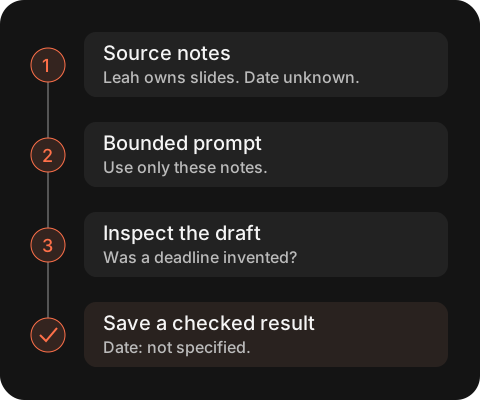
These fictional workshop notes give you everything needed to check the answer. No private documents or paid course are required for the exercise; use a text assistant you are allowed to access.
Workshop notes
Leah will prepare the slides.
Omar will book a room by Thursday.
The workshop date has not been chosen.
Nobody has been assigned to send invitations.
Ask the assistant:
Use only the workshop notes below. Return an action table with
Task, Owner and Deadline, followed by Open questions.
Write "not specified" when an owner or deadline is missing.
Do not treat a room-booking deadline as the workshop date.

[Paste the workshop notes here.]
Compare its response with this reference answer, worked out from the notes rather than captured from a particular model:
| Task | Owner | Deadline |
|---|---|---|
| Prepare slides | Leah | Not specified |
| Book a room | Omar | Thursday |
| Send invitations | Not specified | Not specified |
The open questions are the workshop date, the invitation owner and the missing deadlines. If the response says the workshop is on Thursday, it has confused two different facts. Correct that statement even if the rest of the answer reads well.
Repeat the exercise after changing Omar’s deadline to Monday. Check that the answer changes only the room-booking deadline. This second case helps you see whether the assistant followed the input or repeated its earlier answer.
Start with what the system actually does
AI is a broad label. At work, you will usually encounter systems that classify information, predict a value, retrieve material, generate text or media, or choose actions with tools. These jobs have different failure modes. A writing assistant may invent a fact; a classifier may place an unusual case in the wrong group; an agent may take an unwanted action if its permissions are too broad.
Do not begin with model names. Begin with the job. Write down the input you already have, the result you need and the person who will approve it.
Pick a first task with a cheap mistake
A good practice task has known source material and a reversible result. Summarizing your own meeting notes is safer than sending an unsupervised customer reply. Reformatting a checklist is safer than deciding whether somebody qualifies for credit.
Use four questions:
- Can you inspect the full input?
- Can a person check the answer in a few minutes?
- Will the draft stay private until it is approved?
- Can you undo the action if the answer is wrong?
If any answer is no, choose a smaller task.
Give the model a bounded job
State the task, relevant context, boundaries and requested format. Tell the model what it must leave unknown. A useful instruction might ask for a meeting recap from supplied notes, with separate sections for decisions, owners and unresolved questions. It should also prohibit invented dates or commitments.
That structure matters more than finding a clever phrase. The guide to writing AI prompts shows the method in detail.
Check the output, not the confidence of the prose
Fluent text can still be wrong. Compare names, dates, numbers, quotes and claims with the source. Then check whether the output completed the requested task and respected the format. For higher-risk work, add a second reviewer or a specialist who understands the subject.
NIST’s AI Risk Management Framework addresses risks in the use and evaluation of AI systems. For this exercise, use a small review rule: do not share a draft until each action, owner and date agrees with the notes.
A four-week practice path
Week one: use AI to organize material you already know. Week two: write several versions of one prompt and compare the omissions. Week three: follow a complete workflow with a source boundary and review step. Week four: decide whether one repeated task deserves automation.
Keep a short log so you can inspect what changed. Copy this record for each attempt:
Task:
Source I used:
Result I needed:
First error or omission:
Change to the instruction:
Did the revised answer fix it without adding another error?
Next task to try:
Questions before you continue
Do I need to code first?
You can complete this exercise without writing code. Programming becomes relevant when your chosen task involves building software or connecting systems. Start with the requirements of that task rather than adding coding to every learning plan.
What if the assistant gets the exercise right immediately?
Remove Omar’s name from the notes and try again. The room-booking owner should become unknown. Testing a missing input is more useful here than asking the same question repeatedly.
How do I know what to learn next?
If the answer invents facts, practice source checking. If it ignores the requested table, practice instructions and output formats. If you cannot judge the answer yourself, choose a simpler task or involve someone who understands the subject.
Use the AI skill assessment to choose a practice area, or build your next instruction with the prompt-writing guide. When you have a workplace task ready, the first AI workflow at work shows how to brief it and review the result.