


Build AI skills for work by practicing a small task, checking the result and keeping a record of the correction. Start with a task whose source material you understand, so you can spot a convincing but incorrect answer.
Find the skill to practice
Use this fictional handoff note for a short exercise:
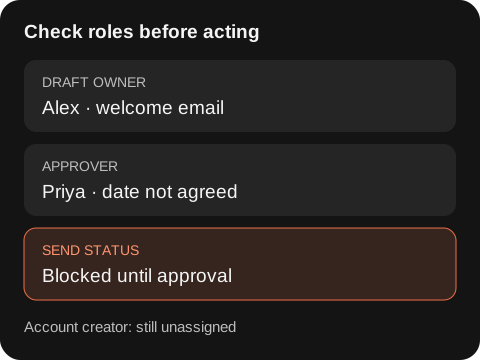
Alex will prepare the welcome email. The account setup needs approval from Priya. No approval date has been agreed. Send nothing to the client until approval arrives.
Ask an AI tool to turn the note into an internal checklist. A usable answer names Alex as the email owner, keeps the approval date unknown and stops before sending anything. Priya is the approver; the note does not say who creates the account.
The table below is a reference for reviewing the answer, not a record of a model test. Choose your next exercise from the error you find.
| If the answer does this | Practice this skill | Change one thing | Check the next answer |
|---|---|---|---|
| Writes a client email instead of a checklist | Task definition | Specify an internal checklist with task, owner and dependency columns | It returns checklist rows, not email prose |
| Says Priya will create the account | Reading evidence | Require a supporting phrase for each assigned owner | Account creation stays unassigned; Priya remains approver |
| Invents a Friday approval deadline | Handling uncertainty | Tell it to write “not agreed” for missing dates | No invented date appears |
| Includes “send welcome email” as an immediate action | Designing handoffs | State that sending depends on approval | Sending is clearly blocked until approval |
Do the exercise with fictional data first. Before using work material, follow your organization’s rules for the tool and the information you can enter.
Start with task design
Describe the job before choosing a tool. Name the audience, the source material, the requested output and the person who will review it. This turns a vague request such as “help with marketing” into a practical one such as “turn approved customer interviews into a one-page message map with quotes and open questions.”
Explicit boundaries give you something to check; they do not guarantee that the model will respect them. If the team has not chosen an owner or deadline, keep that gap visible in the answer.
Practise clear instructions
Clear instructions say what to do, what information controls the answer and how to present it. Add boundaries for facts that must remain unknown, sensitive material that must stay out and actions that need a human approval.
Run the task, find one error and revise the instruction most relevant to that error. Keep the source unchanged for the next attempt so you can compare the answers. A better second answer is useful evidence for that example, but it does not establish that the instruction will work every time.
Learn source and output review
Check factual claims against the source, then check whether the draft helps the next decision. An attractive summary that loses an exception can cause more work than it saves. A useful review checklist covers facts, missing information, format and ownership.
For repeated work, keep two examples: one that should pass and one awkward case that should reveal a problem. The awkward example makes weak instructions visible early.
Turn one skill into a workflow
Combine task design, instructions and review in a five-step process. The client onboarding workflow is useful when several people need the same inputs and handoffs. The market research workflow is useful when sources and uncertainty must remain visible.
Keep a practice record
Copy this record for each attempt. Save the actual answer alongside it, with confidential details removed.
Task and intended reader:
Source used:
Expected output:
Observed error, with the exact sentence:
Instruction changed:
What changed in the next answer:
What still needs a person to decide:
For the handoff exercise, a useful entry would be: “The answer assigned account setup to Priya. I required evidence for each owner. In the next answer, setup was unassigned and Priya was listed only as approver.” This is a sample entry showing what to record, not an actual product result.
Repeat the task with a changed note: Alex now owns the account setup as well as the email. The answer should reflect that new evidence. If it leaves setup unassigned out of habit, your instruction may be too rigid.
Questions about practicing at work
Do I need to learn coding first?
This exercise requires no code. You can practice task definition and review with a text-based AI tool. Building an integration or maintaining software is a separate learning task.
What if the first answer is correct?
Try the changed note and an example with a missing owner. Record which checks pass instead of assuming the task is reliable from one answer.
How should I show the skill to my team?
Share an approved, anonymized source, your instructions and the checked result. Include an example that failed and the correction you made. Avoid claiming a time saving unless you measured the work, including review and rework.
For a task with explicit time and dependency constraints, continue with how to use AI at work. If your handoffs need several steps, use the client onboarding workflow to plan the inputs and approvals.